Define the failure before counting
“Button failure” can describe several different conditions. A press may stop registering, register intermittently, require noticeably more force, fail to return cleanly, or feel different while still producing an input. Cosmetic wear on a cap is another outcome. If the test does not state which condition ends the count, two endurance figures may not be comparable even when both are expressed as presses.
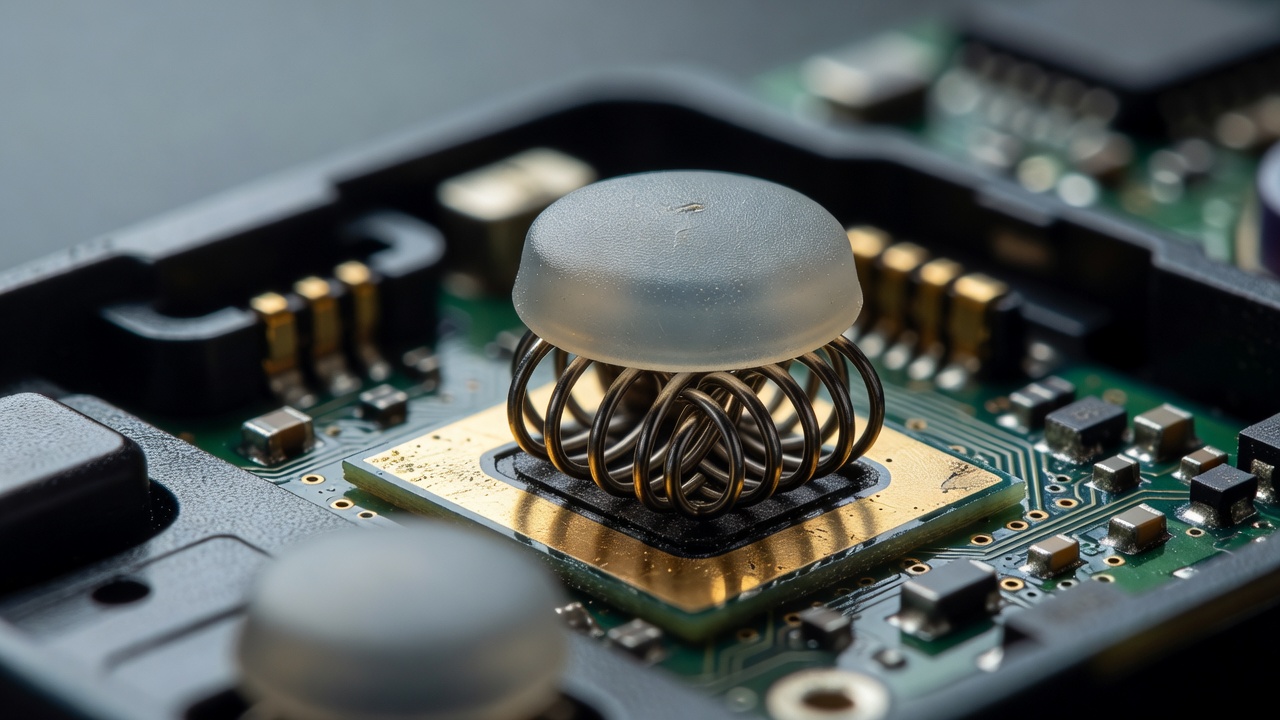
Mechanical switches, membrane contacts and other button constructions do not share one identical wear pathway. Contact materials, spring or dome behaviour, moving parts and assembly tolerances affect the way a press becomes an electrical event. A macro photograph can illustrate a mechanism; it cannot establish the life of a specimen. Claims about a specific internal cause require appropriate inspection and evidence, not an inference from an exterior symptom alone.
What an endurance test applies
A repeated-actuation rig can provide consistency, but it also imposes a particular pattern. The actuator may press at a steady rate with fixed travel and force. A player varies force, pauses, changes finger position and sometimes presses multiple controls in rapid succession. A controlled cycle test answers a focused question about that defined loading pattern; it does not reproduce every use case. Temperature, dust, moisture, orientation and prior handling may also affect outcomes, and should be stated when they are part of the procedure.
- Actuation force
- The force applied to produce a press, measured using a stated method and point of contact.
- Travel
- The distance moved during actuation; fixture geometry and the chosen endpoint matter.
- Cycle rate
- How rapidly presses are repeated, including any rest interval between sequences.
- Failure criterion
- The observable threshold used to classify a sample as no longer meeting the test requirement.
Testing methodology: a practical protocol
| Stage | Procedure | Evidence to retain |
|---|---|---|
| 1 · Characterize | Identify the exact control, specimen and intended test question. | Model, sample identifier, initial condition and environment. |
| 2 · Baseline | Record normal registration, feel, travel and return before cycling. | Input checks, force method and any known variation. |
| 3 · Cycle | Apply a defined force and travel at a controlled rate, with scheduled checks. | Cycle count, interruptions, temperatures and deviations. |
| 4 · Evaluate | Repeat the same functional check and apply the stated failure criterion. | Outcome, uncertainty and whether the test was destructive. |
Use several specimens when the question concerns variation across units; do not let one unusually good or poor sample stand for every controller. Report the number tested and the full spread of outcomes where possible. Keep failures and interrupted runs in the record rather than quietly excluding them. A test fixture should be checked for alignment and repeatability: a press applied off-center may load the cap differently from the intended protocol.
Cause and confounder
Intermittent registration is an observation. Contact wear, contamination, a damaged conductive layer, a cable or board issue and software-side interpretation are possible explanations, each requiring a distinct check. A change in perceived tactility may reflect the cap, the actuator, the user’s expectation or a change in force. Avoid diagnosing a microscopic failure mode from a button that “feels mushy” unless the relevant mechanism has been examined and the evidence supports it.
Comparisons should control the press location, actuator tip, speed, dwell time and measurement system. If the input is tested through a game, its settings and polling path belong in the report. A controller can pass an electrical registration check while feeling inconsistent to a player, so function and feel deserve separate observations. Equally, a tactile preference is not itself proof that a button will fail sooner.
How to read a lifespan claim
Ask what was cycled, under what force and rate, how many samples were tested, and what counted as failure. If those details are absent, treat the number as a claim with limited interpretability. A cycle count is not automatically a calendar lifespan: use intensity, rest periods and the distribution of real play determine how a laboratory sequence relates to an individual player.
Endurance testing is strongest when the endpoint is explicit and the test conditions travel with the result. Counts without context invite false precision.
When comparing controls, pair measured actuation with independent notes on return, sound and perceived feel. Record outliers, preserve raw data and resist converting a narrow experiment into a universal product ranking. The bench can reveal how one sample behaved under one protocol. Broader claims need broader evidence.
Next: account for signal timing →